Why Real Estate is the Foundation of Wealth Creation
March 13, 2024
Discover the transformative power of a wealth mindset in real estate investment.
Read More >>>
.png)


-2.png)
Most investors in commercial real estate (CRE) look for stability and eventually land on the obvious suspects. Net lease retail. Industrial warehouses. Multifamily. But the sector that has quietly outperformed through two financial crises, a global pandemic and a 500-basis-point rate hike cycle tends to get overlooked until institutional money makes it impossible to ignore.
Investing in medical office buildings (MOBs) is no longer a niche strategy. It is a capital allocation decision backed by demographic math, structural shifts in healthcare and lease economics that most individual investors have yet to price in fully. The surface story feels straightforward, but the real wealth-building mechanics operate several layers deeper.
So, what exactly makes this asset class different, and why is institutional capital moving so decisively into it right now?
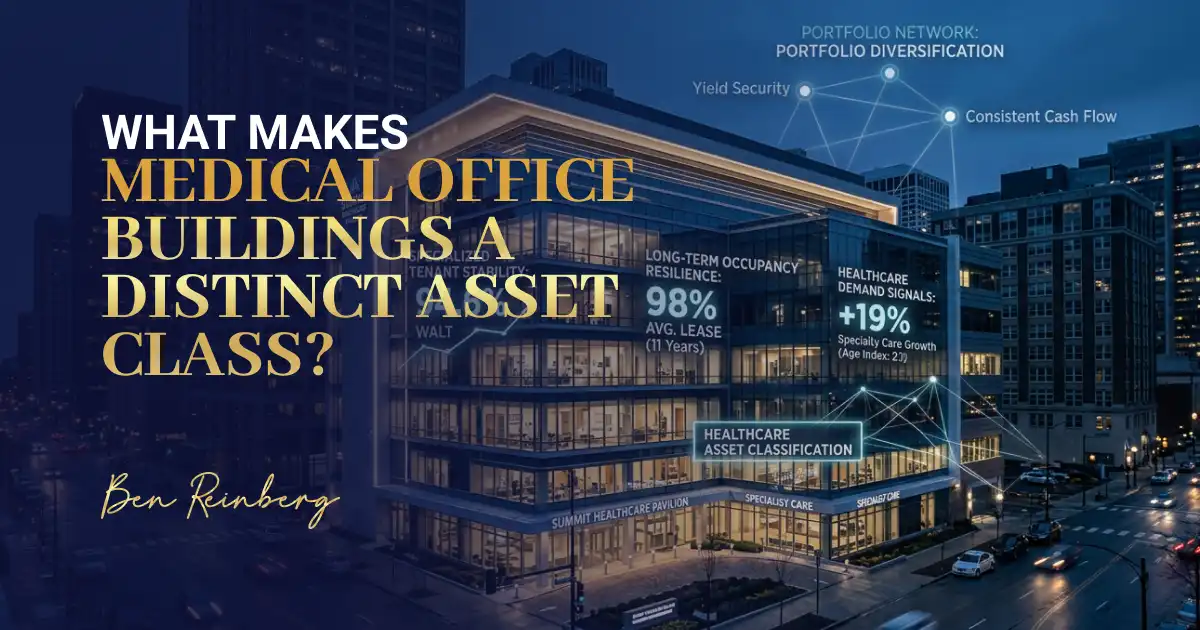
A MOB is not simply office space leased to a doctor. It is a purpose-built commercial property engineered to meet the operational, regulatory and infrastructure demands of clinical healthcare, from basic physician offices to outpatient surgical centers and advanced imaging suites. That specialization is the core of its investment thesis.
The infrastructure required to support a practicing medical tenant; reinforced electrical systems for imaging equipment; enhanced heating, ventilation, and air conditioning (HVAC) for infection control; and Americans with Disabilities Act (ADA)-compliant layouts, costs hundreds of thousands to millions per suite.
Once a practice is established in that space, relocation is financially and operationally prohibitive. That tenant stickiness is what separates medical office real estate from every other commercial category. Medical office real estate serves a wide range of clinical providers, each with distinct infrastructure needs:
Each of these tenant types brings a distinct lease profile, credit quality and retention dynamic, all of which feed directly into the net operating income (NOI) predictability that makes this asset class compelling for long-term investors.

The investment case for commercial real estate medical office is not built on one variable. It is the convergence of structural demand, tenant economics and demographic tailwinds that no other commercial real estate sector can replicate simultaneously.
Healthcare is nondiscretionary. Unlike retail, hospitality or traditional office, demand for medical care does not evaporate during recessions or market downturns. The track record across multiple stress cycles validates this directly:
The aging of the U.S. population represents one of the most powerful structural demand drivers in modern commercial real estate history. By 2030, all baby boomers will be 65 or older, expanding the retirement-age population to approximately 73 million Americans, and older adults consume healthcare services at three to five times the rate of younger demographics.
These are not projections being made in a vacuum. They are validated by the institutional capital already repositioning around them.
Medical tenants invest hundreds of thousands, and often millions, in custom build-outs: Surgical suites, imaging rooms, compliance infrastructure and Health Insurance Portability and Accountability Act (HIPAA)-compliant patient flow layouts that are not portable.
Initial lease terms typically run seven to 15 years, and renewal is almost always the path of least resistance when those terms expire. That structural retention translates directly into predictable NOI, lower vacancy exposure and stronger property valuations over time.

There is no single path into commercial real estate medical office investment. The right approach depends on your capital structure, risk tolerance and whether you are seeking active control or passive exposure.
Before you look at a single property, get honest about what you are working with. How much capital can you deploy? Are you seeking active control or passive income? Your answers shape everything, from the property type you target to the structure of your deal.
Investors with direct market access can pursue commercial real estate medical office acquisitions outright. Those earlier in their journey can use syndications or real estate investment trusts (REITs) to build exposure while they learn the asset class. Know your lane first, then move with conviction.
Not all markets are created equal in medical office real estate. You want your capital where demographic tailwinds and supply constraints work in tandem. Look for metros with a growing 65-plus population, strong healthcare employment and limited new construction.
Sun Belt markets like Phoenix, San Antonio, Dallas-Fort Worth, Texas, and Tampa, Florida, consistently lead on these metrics. The tighter the local occupancy, the stronger your rent growth and tenant retention story will be when it matters most.
Once you have a market, decide how you want to enter it. Direct acquisition gives you full control over tenant selection, lease structure and value-add decisions in commercial real estate medical office investing.
Sale-leaseback transactions let you acquire a property with a creditworthy medical tenant already committed to a long-term triple net lease (NNN) lease, so your income starts on day one with occupancy risk already removed.
In medical office real estate investment, the tenant is the investment. Look beyond the rent check. Is the practice backed by a health system or private equity, or is it a solo operator? What does their payer mix look like? Prioritize leases of at least seven years with built-in annual rent escalations of two to three percent.
The strongest commercial real estate medical investments are anchored by creditworthy tenants on long-duration leases. That combination locks in your NOI, reduces vacancy risk and drives your valuation when you exit.
One medical office building is a strong start. A portfolio of well-located, creditworthy-tenanted assets is where wealth-building in medical real estate really accelerates. Revista data show portfolio cap rates have averaged roughly 63 basis points tighter than single-asset transactions, meaning your exit to an institutional buyer or a healthcare REIT is priced at a measurable premium. Think about aggregation from the beginning of your investing in medical office buildings journey. Every acquisition you make should be underwritten with the portfolio exit in mind, not just the current yield it delivers today.
Do not leave money on the table at tax time. Direct ownership of commercial real estate medical office properties gives you access to depreciation deductions, cost segregation studies that accelerate write-offs on medical-grade infrastructure over five- to 15-year schedules, and 1031 exchange provisions that let you roll proceeds into your next acquisition without triggering capital gains. These tools are not available to REIT investors. They are a structural advantage of owning medical real estate directly, and they compound meaningfully over a long hold period.
In medical office real estate, the gap between a well-structured investment and a costly mistake often comes down to market knowledge, tenant relationships and deal sourcing. Partnering with an experienced commercial real estate investor provides you with access that cannot be replicated on its own:
The more your capital aligns with experienced operators who understand the structural dynamics of the commercial real estate medical office sector, the more precisely you can target the returns that make this sector compelling.

If you have been looking for a commercial real estate sector that holds through volatility, generates predictable income and gives you a credible institutional exit, medical office real estate is worth your serious attention. The demand is structural. The tenants are sticky. The capital dynamics are shifting in a direction that rewards investors who move before the broader market catches up.
As someone who has built and managed a $500M+ commercial real estate portfolio with a proven 28% historical internal rate of return (IRR), I can assure you that success in investing in medical office buildings lies in focusing on acquisitions grounded in solid fundamentals. That means institutional-grade tenants, long-duration leases and resilient property types, including medical office buildings, veterinary clinics and industrial real estate that hold through cycles and compound across them.
Let's connect today to explore where shared market exposure in medical real estate makes sense for your portfolio.
Start with your network, experienced CRE investors, healthcare operators and capital partners who have deployed capital in this sector. Look for track records in MOB acquisitions, not just general commercial brokerage. The right partner brings deal flow, tenant relationships and market data you cannot replicate on your own.
Yes, and the data backs it. Healthcare demand is nondiscretionary, tenant retention is structurally high and the aging U.S. population guarantees sustained demand for outpatient space. For seasoned investors, the stronger question is not if but where and how to size the position correctly.
The entry barriers are real but navigable. Direct MOB acquisition requires capital, local market expertise and familiarity with healthcare real estate due diligence, which is more rigorous than standard commercial property, given the specialized physical infrastructure and tenant dynamics involved. For investors researching how to invest in commercial real estate, REITs, syndications and structured partnerships can provide exposure to medical office buildings with lower minimum investment requirements. Partnering with an experienced operator accelerates both access and decision quality regardless of capital size.
Evaluation centers on four variables: Tenant credit quality and lease structure, physical infrastructure condition, market demographics and supply constraints and exit pathway clarity. Apply cap rate analysis using NOI divided by property value, stress-test vacancy scenarios against your debt service and assess each tenant's payer mix and renewal likelihood.